Pope's Criticism on Criticism" is a didactic poem in heroic couplets, begun, perhaps, Analysis early asand published, anonymously, in The poetic essay was a relatively new genre, and the "Essay" itself was Pope's Sparknotes ambitious work to that time · Analysis of Alexander Pope’s An Essay on Criticism By Nasrullah Mambrol on July 8, • (1) An Essay on Criticism () was Pope’s first independent work, published anonymously through an obscure bookseller [12–13]. Its implicit claim to authority is not based on a lifetime’s creative work or a prestigious commission but, riskily, on the skill and argument of the poem blogger.comted Reading Time: 8 mins We also offer services on an essay on criticism analysis. Given an essay on criticism text, we are able to read and analyze it for you. Our Services on Pope Essay On Criticism. To be able to understand the alexander Pope essay on criticism, you need to take good time to read and understand the Pope’s poetic work. We are the experts in reviewing Alexander Pope’s essay on criticism
Pope An Essay On Criticism Sparknotes - Essay on criticism sparknotes pope
Alexander Pope, a translator, poet, wit, amateur landscape gardener, and satirist, was born in London in He contracted tuberculosis of the bone when he was young, which disfigured his spine and purportedly only allowed him to grow to 4 feet, 6 inches.
Though he remained in ill health throughout his life, he was able to support himself as a translator and writer. As a Catholic at that time in Britain, he was ineligible for patronage, public office, or a position at a university. A sharp-penned satirist of public figures and their behavior, Pope had his supporters and detractors. He was friends with Jonathan Swift, Dr.
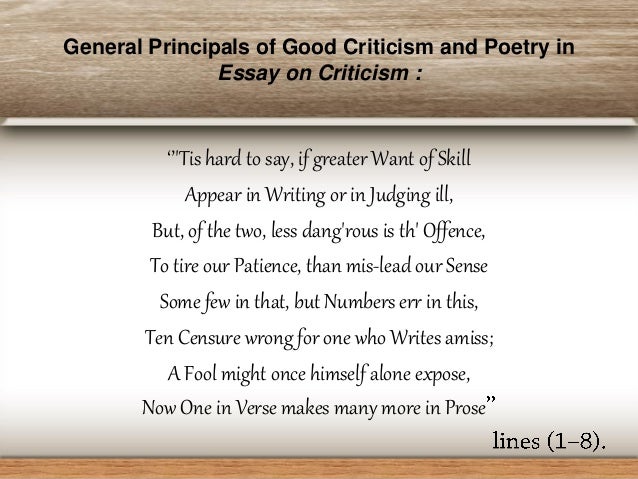
John Arbuthnot, and John Gay. Written in heroic couplets, the tone is straight-forward and conversational. It is a discussion of what good critics should do; however, in reading it one gleans much wisdom on the qualities poets should strive for in their own work. Some few in that, but numbers err in this, Ten censure wrong for one who writes amiss; A fool might once himself alone expose, Now one in verse makes many more in prose.
In poets as true genius is but rare, True taste as seldom is the critic's share; Both must alike from Heav'n derive their light, These born to judge, as well as those to write. Let such teach others who themselves excel, And censure freely who have written well.
Authors are partial to their wit, 'tis true, But are not critics to their judgment too? Yet if we look more closely we shall find Most have the seeds of judgment in their mind; Nature affords at least a glimm'ring light; The lines, tho' touch'd but faintly, are drawn right, pope essay on criticism analysis. But as the slightest sketch, if justly trac'd, Is by ill colouring but the more disgrac'd, So by false learning is good sense defac'd; Some are bewilder'd in the maze of schools, And some made coxcombs Nature meant but fools.
In search of wit these lose their common sense, And then turn critics in their own defence: Each burns alike, who can, or cannot write, Or with a rival's, or an eunuch's spite. All fools have still an itching to deride, And fain would be upon the laughing side. If Mævius scribble in Apollo's spite, There are, who judge still worse than he can write. Some have at first for wits, then poets pass'd, Turn'd critics next, and prov'd plain fools at last; Some neither can for wits nor critics pass, As heavy mules are neither horse nor ass.
Those half-learn'd witlings, num'rous in our isle As half-form'd insects on the banks of Nile; Unfinish'd things, one knows not what to call, Their generation's so equivocal: To tell 'em, would a hundred tongues require, Or one vain wit's, that might a hundred tire. But you who seek to give and merit fame, And justly bear a critic's noble name, Be sure your self and your own pope essay on criticism analysis to know, How far your genius, pope essay on criticism analysis, taste, and learning go; Launch not beyond your depth, pope essay on criticism analysis, but be discreet, And mark that point where sense and dulness meet.
Nature to all things fix'd the limits fit, And wisely curb'd proud man's pretending wit: As on the land while here the ocean gains, In other parts it leaves wide sandy plains; Thus in the soul while memory prevails, The solid pow'r of understanding fails; Where beams of warm imagination play, The memory's soft figures melt away. One science only will one genius fit; So vast is art, so narrow human wit: Not only bounded to peculiar arts, But oft in those, confin'd to single parts. Like kings we lose the conquests gain'd before, By vain ambition still to make them more; Each might his sev'ral province well command, Would all but stoop to what they understand.
First follow NATURE, and your judgment frame By her just standard, which is still the same: Unerring Nature, still divinely bright, One clear, unchang'd, and universal light, Life, force, and beauty, must to all impart, At once the source, and end, and test of art. Art from that fund each just supply provides, Works without show, and without pomp presides: In some fair body thus th' informing soul With spirits feeds, with vigour fills the whole, Each motion guides, and ev'ry nerve sustains; Pope essay on criticism analysis unseen, but in th' effects, remains.
Some, to whom Heav'n in wit has been profuse, Want as much more, to turn it to its use; For wit and judgment often are at strife, Though meant each other's aid, like man and wife. Those RULES of old discover'd, not devis'd, Are Nature still, but Nature methodis'd; Nature, like liberty, is but pope essay on criticism analysis By the same laws which first herself ordain'd.
Hear how learn'd Greece her useful rules indites, When to repress, and when indulge our flights: High on Parnassus' top her sons she show'd, And pointed out those arduous paths they trod; Held from afar, aloft, th' immortal prize, And urg'd the rest by equal steps to rise.
Just precepts thus from great examples giv'n, She drew from them what they deriv'd from Heav'n. The gen'rous critic fann'd the poet's fire, And taught the world with reason to admire, pope essay on criticism analysis. Then criticism the Muse's handmaid prov'd, To dress her charms, and make her more belov'd; But following wits from that intention stray'd; Who could not win the mistress, woo'd the maid; Against the poets their own arms they turn'd, Sure to hate most the men from whom they learn'd.
So modern 'pothecaries, taught the art By doctor's bills to play the doctor's part, Bold in the practice of mistaken rules, Prescribe, apply, and call their masters fools. Some on the leaves of ancient authors prey, Nor time nor moths e'er spoil'd so much as they: Some drily plain, without invention's aid, Write dull receipts how poems may be made: These leave the sense, their learning to display, And those explain the meaning quite away.
You then whose judgment the right course would steer, Know well each ANCIENT'S proper character; His fable, pope essay on criticism analysis, subject, scope in ev'ry page; Religion, country, pope essay on criticism analysis, genius of his age: Without all these at once before your eyes, Cavil you may, but never criticise.
Be Homer's works your study and delight, Read them by day, and meditate by night; Thence form your judgment, thence your maxims bring, And trace the Muses upward to their spring; Still with itself compar'd, his text peruse; And let your comment be the Mantuan Muse.
When first young Maro in his boundless mind A work t' outlast immortal Rome design'd, Perhaps he seem'd above the critic's law, And but from Nature's fountains scorn'd to draw: But when t' examine ev'ry part he came, Nature and Homer were, he found, the same. Convinc'd, amaz'd, he checks the bold design, And rules as strict his labour'd work confine, As if the Stagirite o'erlook'd each line. Learn hence for ancient rules a just esteem; To copy nature is to copy them.
Some beauties yet, no precepts can declare, For there's a happiness as well as care. Music resembles poetry, in each Are nameless graces which no methods teach, And which a master-hand alone can reach. If, where the rules not far enough extend, Since rules were made but to promote their end Some lucky LICENCE answers to the full Th' intent propos'd, that licence is a rule. Thus Pegasus, a nearer way to take, May boldly deviate from the common track, pope essay on criticism analysis.
Great wits sometimes may gloriously offend, And rise to faults true critics dare not mend; From vulgar bounds with brave disorder part, And snatch a grace beyond the reach of art, Which, without passing through the judgment, gains The heart, and all its end at once attains. In prospects, thus, some objects please our eyes, Which out of nature's common order rise, The shapeless rock, or hanging precipice.
But tho' the ancients thus their rules invade, As kings dispense with laws themselves have made Moderns, beware! or if you must offend Against the precept, ne'er transgress its end; Let it be seldom, and compell'd by need, And have, at least, their precedent to plead. The critic else proceeds without remorse, Seizes your fame, and puts his laws in force. I know there are, to whose presumptuous thoughts Pope essay on criticism analysis freer beauties, ev'n in them, seem faults.
Some figures monstrous and misshap'd appear, Consider'd singly, or beheld too near, Which, but proportion'd to their light, or place, Due distance reconciles to form and grace.
A prudent chief not always must display His pow'rs in equal ranks, and fair array, But with th' occasion and the place comply, Conceal his force, nay seem sometimes to fly. Those oft are stratagems which errors seem, Nor is it Homer nods, but we that dream. Still green with bays each ancient altar pope essay on criticism analysis, Above the reach of sacrilegious hands, pope essay on criticism analysis, Secure from flames, from envy's fiercer rage, Destructive war, and all-involving age.
See, from each clime the learn'd their incense bring! Hear, in all tongues consenting pæans ring! In praise so just let ev'ry voice be join'd, And fill the gen'ral chorus of pope essay on criticism analysis Hail, bards triumphant!
born in happier days; Immortal heirs of universal praise! Whose honours with increase of ages grow, As streams roll down, enlarging as they flow! Nations unborn your mighty names shall sound, And worlds applaud that must not yet be found! Oh may some spark of your celestial fire The last, the meanest of your sons inspire, That on weak wings, from far, pope essay on criticism analysis, pursues your flights; Glows while he reads, but trembles as he writes To teach vain wits a science little known, T' admire superior sense, and doubt their own!
Of all the causes which conspire to blind Man's erring judgment, and misguide the mind, What the weak head with strongest bias rules, Pope essay on criticism analysis pride, the never-failing vice of fools. Whatever Nature has in worth denied, She gives in large recruits of needful pride; Pope essay on criticism analysis as in bodies, thus in souls, we find What wants in blood and spirits, swell'd with wind; Pride, where wit fails, steps in to our defence, And fills up all the mighty void of sense!
If once right reason drives that cloud away, pope essay on criticism analysis, Truth breaks upon us with resistless day; Trust not yourself; but your defects to know, Make use of ev'ry friend—and ev'ry foe. A little learning is a dang'rous thing; Drink deep, or taste not the Pierian spring: There shallow draughts intoxicate the brain, And drinking largely sobers us again. Fir'd at first sight with what the Muse imparts, In fearless youth we tempt the heights of arts, While from the bounded level of our mind, Short views we take, nor see the lengths behind, But more advanc'd, behold with strange surprise New, distant scenes of endless science rise!
So pleas'd at first, the tow'ring Alps we try, Mount o'er the vales, and seem to tread the sky; Th' eternal snows appear already past, And the first clouds and mountains seem the last; But those attain'd, we tremble to survey The growing labours of the pope essay on criticism analysis way, Th' increasing prospect tires our wand'ring eyes, Hills peep o'er hills, and Alps on Alps arise! A perfect judge will read each work of wit With the same spirit that its author writ, Survey the whole, nor seek slight faults to find, Where nature moves, and rapture warms the mind; Nor lose, for that malignant dull delight, The gen'rous pleasure to be charm'd pope essay on criticism analysis wit.
But in such lays as neither ebb, nor flow, Correctly cold, and regularly low, That shunning faults, one quiet tenour keep; We cannot blame indeed—but we may sleep. In wit, as nature, what affects our hearts Is not th' exactness of peculiar parts; 'Tis not a lip, or eye, we beauty call, But the joint force and full result of all.
Thus when we view some well-proportion'd dome, The world's just wonder, and ev'n thine, O Rome! Whoever thinks a faultless piece to see, Thinks what ne'er was, nor is, nor e'er pope essay on criticism analysis be. In ev'ry work regard the writer's end, Since none can compass more than they pope essay on criticism analysis And if the means be just, the conduct true, Applause, in spite of trivial faults, is due.
As men of breeding, sometimes men of wit, T' avoid great errors, must the less commit: Neglect the rules each verbal critic lays, For not to know such trifles, is a praise. Most critics, fond of some subservient art, Still make the whole depend upon a part: They talk of principles, but notions prize, And all to one lov'd folly sacrifice. Once on a time, La Mancha's knight, they say, A certain bard encount'ring on the way, Discours'd in terms as just, with looks as sage, As e'er could Dennis of the Grecian stage; Concluding all were desp'rate sots and fools, Who durst depart from Aristotle's rules.
Our author, happy in a judge so nice, Produc'd his play, and begg'd the knight's advice, Made him observe the subject and the plot, The manners, passions, unities, what not? All which, exact to rule, were brought about, Were but a combat in the lists left out. leave the combat out? Some to conceit alone their taste confine, And glitt'ring thoughts struck out at ev'ry line; Pleas'd with a work where nothing's just or fit; One glaring chaos and wild heap of wit.
Poets, like painters, thus, unskill'd to trace The naked nature and the living grace, With gold and jewels cover ev'ry part, And hide with ornaments their want of art. True wit is nature to advantage dress'd, What oft was thought, but ne'er so well express'd, Something, whose truth convinc'd at sight we find, That gives us back the image of our mind.
As shades more sweetly recommend the light, So modest plainness sets off sprightly wit. For works may have more wit than does 'em good, As bodies perish through excess of blood.
Others for language all their care express, And value books, as women men, for dress: Their praise is still—"the style is excellent": The sense, they humbly take upon content. Words are like leaves; and where they most abound, Much fruit of sense beneath is rarely found. False eloquence, like the prismatic glass, Its gaudy colours spreads on ev'ry place; The face of Nature we no more survey, All glares alike, without distinction gay: But true expression, like th' unchanging sun, Clears, and improves whate'er it shines upon, It gilds all objects, but it alters none.
Expression is the dress of thought, and still Appears more decent, as more suitable; A vile conceit in pompous words express'd, Is like a clown in regal purple dress'd: For diff'rent styles with diff'rent subjects sort, As several garbs with country, town, and court. Some by old words to fame have made pretence, Ancients in phrase, pope essay on criticism analysis, mere moderns in their sense; Such labour'd nothings, in so strange a style, Amaze th' unlearn'd, and make the learned smile.
Unlucky, as Fungoso in the play, These sparks with awkward vanity display What the fine gentleman wore yesterday! And but so mimic ancient wits at best, As apes our grandsires, in their doublets dress'd.
In words, as fashions, the same rule will hold; Alike fantastic, if too new, or old; Be not the first by whom the new are tried, Not yet the last to lay the old aside. But most by numbers judge a poet's song; And smooth or rough, with them is right or wrong: In the bright Muse though thousand charms conspire, Her voice is all these tuneful fools admire, Who haunt Parnassus but to please their ear, Not mend their minds; as some to church repair, Not for the doctrine, but the music there.
These equal syllables alone require, Tho' oft the ear the open vowels tire, While expletives their feeble aid do join, And ten low words oft creep in one dull line, While they ring round the same unvaried chimes, With sure returns of still expected rhymes.
Where'er you find "the cooling western breeze", In the next line, it "whispers through the trees": If "crystal streams with pleasing murmurs creep", The reader's threaten'd not in vain with "sleep".
Then, at the last and only couplet fraught With some unmeaning thing they call a thought, A needless Alexandrine ends the song, That, like a wounded snake, drags its slow length along. Leave such to tune their own dull rhymes, and know What's roundly smooth, or languishingly slow; And praise the easy vigour of a line, Where Denham's strength, and Waller's sweetness join.
True ease in writing comes from art, not chance, As those move easiest who have learn'd to dance. Soft is the strain when Zephyr gently blows, And the smooth stream in smoother numbers flows; But when loud surges lash the sounding shore, The hoarse, rough verse should like the torrent roar.
Lit Analysis Essay From Scratch: Pope's \
, time: 14:11Pope An Essay On Criticism - Poets' Corner - Alexander Pope - An Essay on Criticism

Pope's Criticism on Criticism" is a didactic poem in heroic couplets, begun, perhaps, Analysis early asand published, anonymously, in The poetic essay was a relatively new genre, and the "Essay" itself was Pope's Sparknotes ambitious work to that time · “An Essay on Criticism” () is a work of both poetry and criticism. Pope attempts in this long, three-part poem to examine neoclassical aesthetics in poetry and argues that the best kind of · Analysis of Alexander Pope’s An Essay on Criticism By Nasrullah Mambrol on July 8, • (1) An Essay on Criticism () was Pope’s first independent work, published anonymously through an obscure bookseller [12–13]. Its implicit claim to authority is not based on a lifetime’s creative work or a prestigious commission but, riskily, on the skill and argument of the poem blogger.comted Reading Time: 8 mins



No comments:
Post a Comment